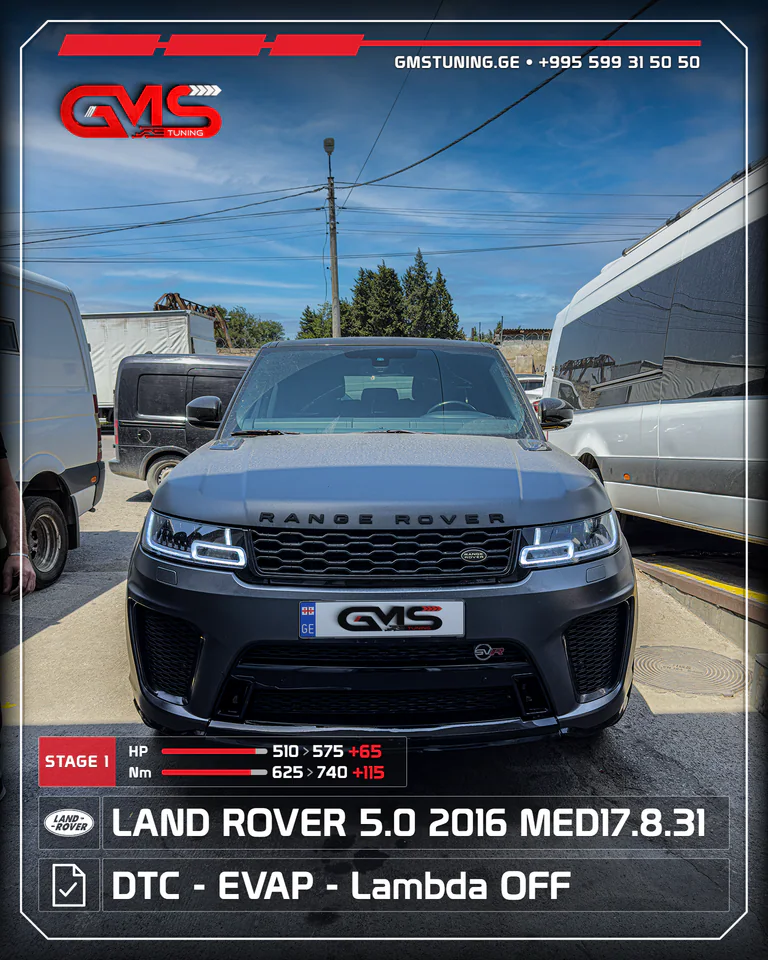
Work completed
Land Rover Sport
2016 · 5.0 L
Stage 1 calibration. DTC, EVAP, Lambda software deactivation.
View this projectDTC service in Tbilisi
A DTC (Diagnostic Trouble Code) is a diagnostic fault code recorded in the control unit. If Check Engine is on or a code returns after clearing, we identify the cause and check changes already made to the vehicle. We then explain whether repair is needed or whether software deactivation of the specific code is possible.

The engine indicator is on. Selected P0420 and historical P0135 are shown as examples.
How the system works
A DTC (Diagnostic Trouble Code) is a diagnostic fault code. The ECU records it when a signal or system operation does not match expectations. The code points to what needs checking; we identify the cause using live data and component inspection.
Clearing codes with a scanner does not change the ECU’s diagnostic logic. If the cause remains, the code may reappear under the relevant conditions.
With DTC OFF, we modify the ECU software so the agreed code is no longer reported. Before doing so, we check its cause, changes already made to the vehicle and its connection with engine control.
Work is possible on suitable gasoline and diesel ECUs.
When the service may be needed
Check Engine comes on or the code returns after clearing. We check whether the cause is an unresolved fault or a mismatch between an existing modification and the software.
A part has been replaced or removed, or the software has been modified, but codes still appear. We determine whether code deactivation is sufficient or the control logic also needs correction.
Using a correctly read ECU file and diagnostic data, we check whether selected codes can be deactivated. We return the processed file to the specialist.
Deactivating a code does not mean removing limp mode. The ECU may limit power even without a code. Faults in sensors, actuators, wiring, the engine, or the fuel and air systems require separate diagnostics and repair. Additional software or mechanical work is agreed in advance.
Stages
Questions and answers
In many cases, yes. We assess feasibility based on the cause of the code, the ECU and software version. We also check modifications already made to the vehicle.
No. Turning the indicator off does not repair a damaged part. We verify the result using live data and vehicle operation. Check Engine may come on again because of another fault.
Deactivating only the relevant codes does not fully change the control logic of these systems. Their deactivation requires the corresponding software work. If mechanical work is also needed, we agree it separately.
The offer applies to vehicles in Georgia. You must follow our social media pages. Send the model, year, engine, VIN, ECU information, a correctly read file and the full list of faults. Briefly describe the symptom, diagnostic results, modifications made and the reason for deactivating the codes. Only processing selected codes in a supported file is free. A local specialist performs diagnostics, reading, writing and testing. Full software deactivation of DPF/EGR/AdBlue and other services are not included in the offer.
Work completed
2016 · 5.0 L
Stage 1 calibration. DTC, EVAP, Lambda software deactivation.
View this projectInclude the vehicle model, year and engine. Attach the codes or a diagnostic photo and briefly describe the symptom or modifications already made. We will explain what needs checking. Consultation is free.