

Work completed
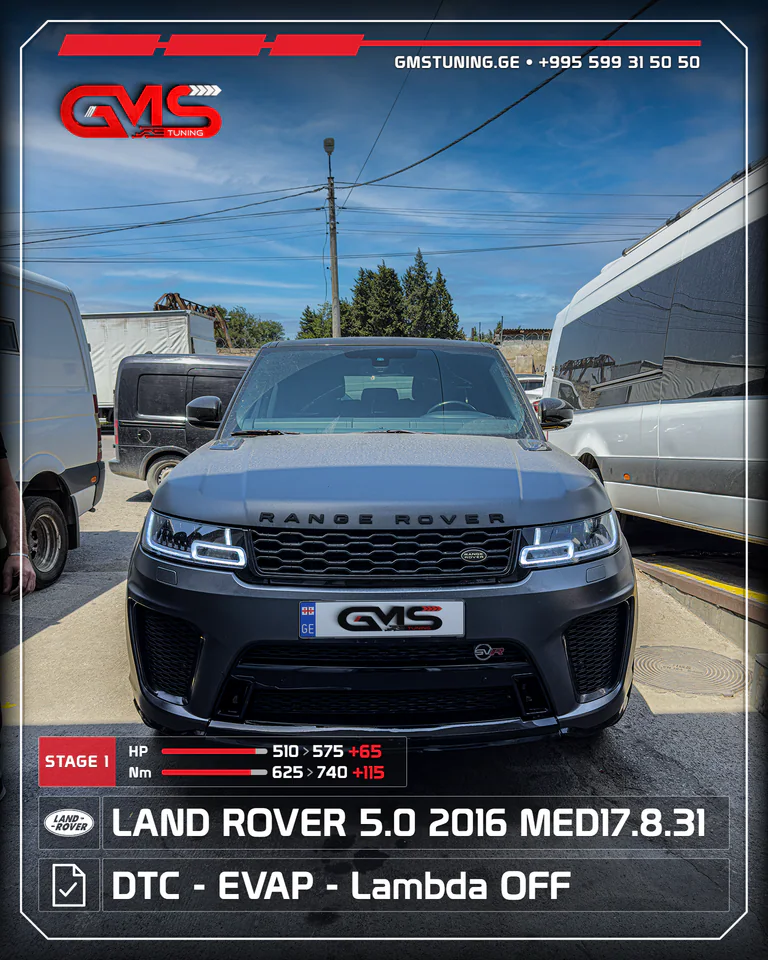
Land Rover Sport
2016 · 5.0 L
Stage 1 calibration. DTC, EVAP, Lambda software deactivation.
View this projectLambda service in Tbilisi
A lambda sensor (oxygen sensor) measures oxygen content in the exhaust. When catalyst or lambda-sensor fault codes appear, we diagnose the cause and explain whether repair or part replacement is needed, or whether software deactivation is possible.

Normal operation
The ECU uses front-sensor data to adjust the air-to-fuel ratio. The rear sensor helps check catalyst operation and shows a steadier signal in this example.
System operation
A lambda sensor, or oxygen sensor, reports exhaust oxygen content to the ECU. On gasoline engines, these data are used for mixture control; on diesel engines, depending on the system, they can also be used to control air, EGR and fuel injection.
In many gasoline systems, the upstream sensor helps control the mixture, while the downstream sensor is used to monitor the catalyst. Sensor count and functions vary; in some systems, downstream-sensor data also contribute to fuel correction.
Lambda OFF disables software control of the selected sensor and the associated monitoring. It is often possible to disable rear-sensor control and, on some models, front-sensor control as well. We preserve functions essential to engine management.
The work is performed in the ECU file, without an additional emulator.
Identifying the problem
Check Engine and a P0420 or P0430 code do not necessarily mean the sensor is damaged. We check the catalyst, sensors, engine operation and exhaust leaks.
A code appears after catalyst removal or replacement, or returns after clearing. We check the exhaust modification and monitoring; clearing the code cannot resolve its cause.
A signal, heater or wiring fault requires separate inspection. When fuel consumption rises or the engine runs unevenly, we also check mixture control and other possible causes.
Software changes cannot restore a damaged part. A clogged catalyst, leaks and misfires require separate inspection and appropriate repair. Installing a suitable, functioning catalyst does not by itself require Lambda OFF.
Steps
Questions and answers
The work usually concerns disabling rear-sensor control. We generally do not deactivate the front sensor, although its control can be disabled on some vehicles, including certain diesels. We check the specific engine, ECU and each sensor's function.
No. These codes concern catalyst-efficiency monitoring and cannot identify a damaged part on their own. We check sensors, exhaust leaks, engine operation and catalyst condition.
Disconnecting the connector alone does not disable sensor control in the ECU and may cause new faults. During software deactivation, we check whether the sensor must remain connected on the specific vehicle or whether its connector can also be disconnected.
No. Disabling sensor control or monitoring cannot physically clean the exhaust or replace the catalyst. The inspection result depends on vehicle condition and compliance with current requirements. We cannot promise a pass in advance.
Work completed
2016 · 5.0 L
Stage 1 calibration. DTC, EVAP, Lambda software deactivation.
View this projectSend us the model, year and engine. Include the fault code and tell us whether the catalyst or exhaust system has been changed; we will explain which checks are needed. Consultation is free.