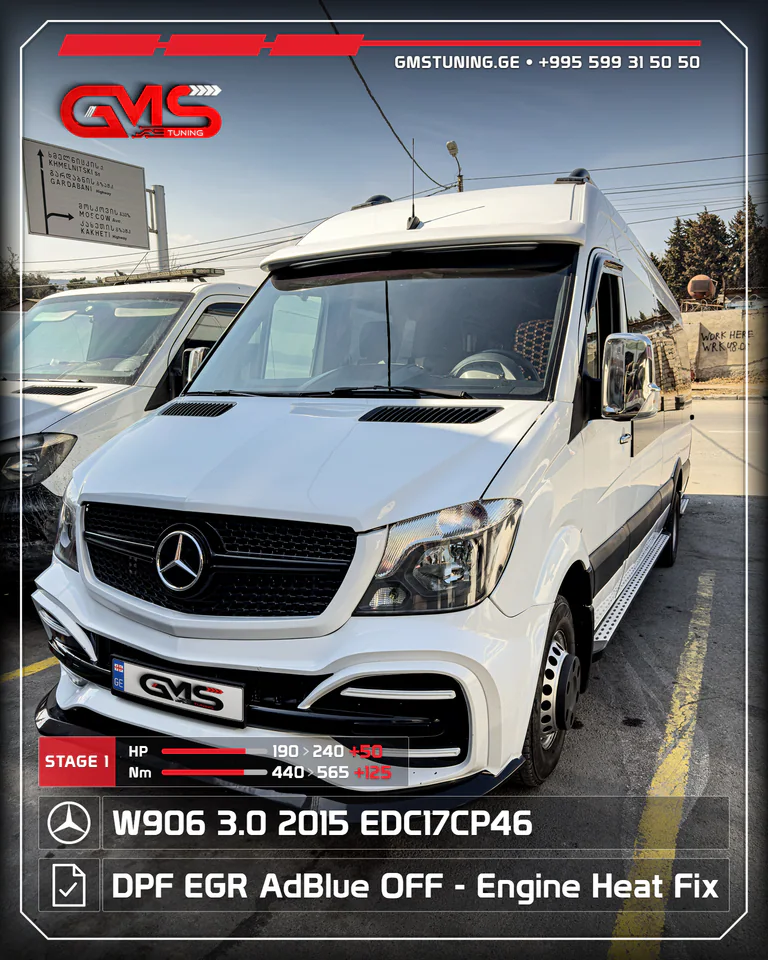
Work completed
Mercedes-Benz W906
2015 · 3.0 L
Stage 1 calibration. DPF, EGR, AdBlue software deactivation. Operating temperature calibration (Engine Heat Fix).
View this projectEngine Heat Fix in Tbilisi
Engine Heat Fix is a software adjustment of engine operating temperature. If the cooling system is working properly and the ECU supports it, we change thermostat and fan control settings to reduce the factory operating temperature.

Factory control
In this example, the thermostat gradually opens and the fan starts operating from 105°C. At 110°C, the thermostat is fully open and the fan speed reaches about 80%. The coolant then cools, the thermostat gradually closes and the fan slows down.
How the system works
The thermostat regulates coolant flow. On some models, the ECU influences its opening through an electric heater; a conventional mechanical thermostat is not controlled this way.
The factory cooling strategy changes with load and operating conditions. Before making adjustments, we check the existing software logic and actual temperature data.
With Engine Heat Fix, we coordinate adjustments to supported thermostat and fan controls. Actual temperature depends on the system’s capabilities, load and environment.
Support on gasoline and diesel engines depends on the ECU and thermostat type.
Checks before work
We read sensor data and fault codes, and compare temperature with the factory strategy. We check the thermostat, fan and their electrical control.
We check the coolant, pump, leaks, air in the system, radiator cleanliness and flow, and airflow. Earlier fan activation cannot resolve restricted circulation.
We clarify driving conditions and previous tuning. We tailor calibration to actual use and the system’s capabilities. Any fault found must be repaired before software changes.
This service changes actual control settings. Hiding the temperature reading or disabling overheating warnings and engine-protection settings is not included. Changes are made in the ECU file, without an additional emulator.
Steps
Questions and answers
If the cause is a cooling-system fault, repairs are needed first. Software adjustment changes operating-temperature control settings but cannot fix a faulty radiator, pump, thermostat or fan.
There is no single value for every vehicle. We select operating temperature for the specific engine and available control capabilities, and verify the actual result with data. Load, ambient temperature and cooling-system condition determine the actual reading.
No. A conventional mechanical thermostat is not controlled by the ECU. For an electrically controlled thermostat, we check whether the ECU allows its settings to be changed. If the fan is also ECU-controlled, we coordinate adjustments to both controls when reducing the temperature.
Changing the temperature strategy may affect engine warm-up, fuel consumption, emissions and fan operation. The extent depends on the engine and calibration. We agree the changes in advance and check operation.
Work completed
2015 · 3.0 L
Stage 1 calibration. DPF, EGR, AdBlue software deactivation. Operating temperature calibration (Engine Heat Fix).
View this projectSend us the model, year, engine and current temperature reading. Also mention any cooling-system work already done — we will explain which checks are needed. Consultation is free.