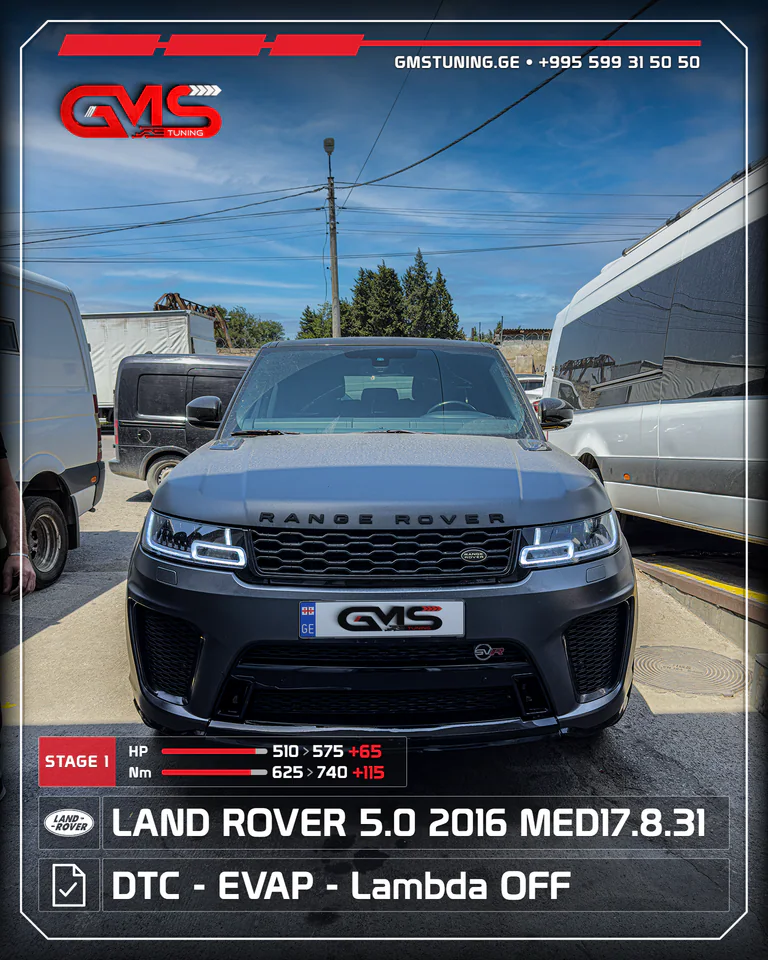
Work completed
Land Rover Sport
2016 · 5.0 L
Stage 1 calibration. DTC, EVAP, Lambda software deactivation.
View this projectEVAP OFF service in Tbilisi
EVAP (Evaporative Emission Control System) prevents fuel vapour from escaping into the atmosphere. If a fault returns after clearing, we check the system and determine whether software deactivation is possible for the specific ECU.

Vapour storage
Vapour from the tank collects in the charcoal canister. In this example, the purge valve leading to the engine is closed. The tank ventilation path is retained.
How the system works
EVAP is a fuel vapour containment system. The charcoal canister captures vapour from the petrol tank so that it does not escape directly into the atmosphere.
While the engine runs, the ECU controls the purge valve. Stored vapour is metered into the intake manifold and burns with the fuel mixture. In many vehicles, the system also checks for leaks.
A fault may be caused by the valve, charcoal canister, fuel cap, hose or wiring. EVAP OFF changes the system’s software control and monitoring; the work required depends on the ECU and configuration.
The work concerns EVAP control. We check other fuel delivery and mixture control faults separately.
Recognising the problem
Check Engine and an EVAP fault code return after clearing. Diagnostics help us determine whether the issue involves a leak, flow or an electrical circuit.
If starting is difficult or the engine runs unevenly, we check the purge valve and mixture data. This symptom alone does not establish the cause.
We check the charcoal canister, connections and wiring. Before software work, we determine whether physical damage needs repair.
Software cannot eliminate fuel leaks or odours. Essential tank ventilation must remain intact. A stuck valve or damaged hose requires the appropriate mechanical repair.
Stages
Questions and answers
No. Clearing a code temporarily removes the stored fault. Software work changes the relevant EVAP control and monitoring according to the capabilities of the specific ECU.
No. A damaged hose, charcoal canister, fuel cap or other physical leak needs repair. A software change cannot seal the fuel system.
It depends on the condition of the component. A stuck valve or damaged connection must be repaired separately. Essential tank ventilation must not be blocked.
No. We determine feasibility according to ECU type, software version and EVAP configuration. Send us the model, year, engine and fault code.
Work completed
2016 · 5.0 L
Stage 1 calibration. DTC, EVAP, Lambda software deactivation.
View this projectSend us the vehicle model, year, engine and fault code. Also mention if the problem appears after refuelling or a part has been replaced. Consultation is free.